How Much Is Your Home Worth?

Contact
Brokerage name
License #: 53698
License #: 268528
211 East Palace Avenue, Santa FE, NM, 87501
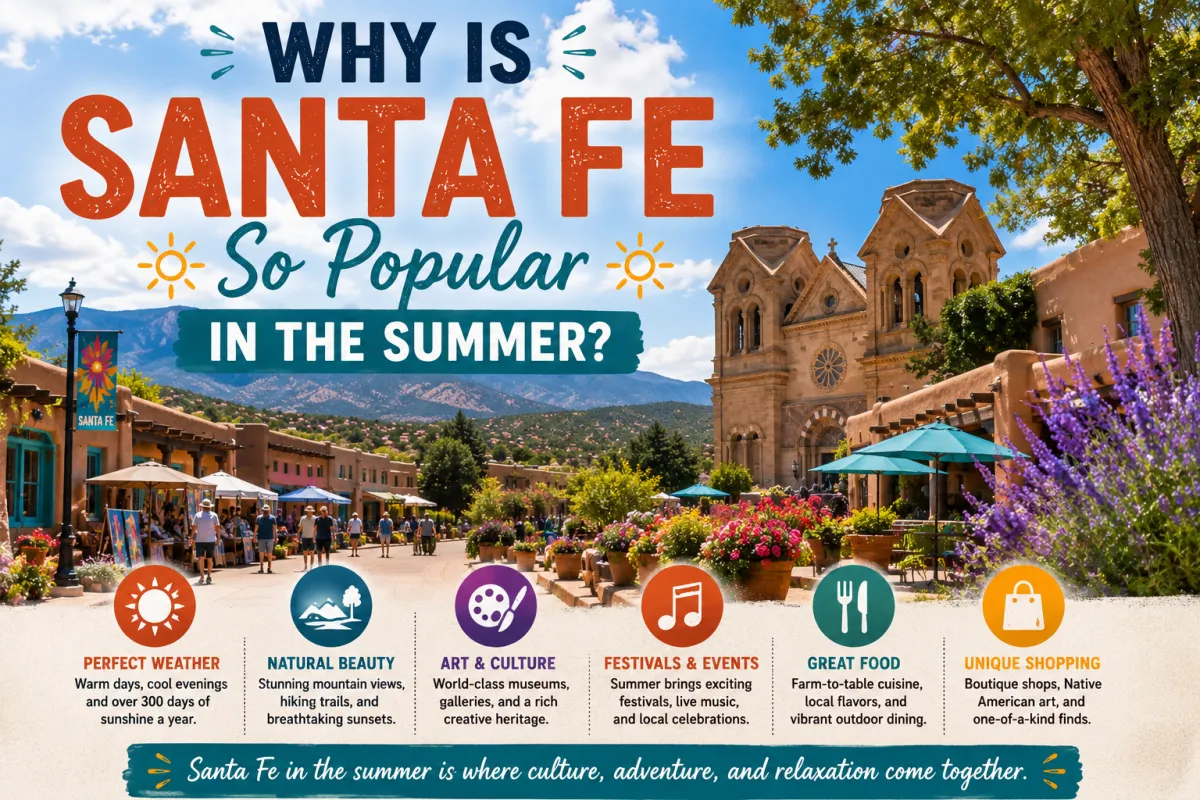
Why Is Santa Fe So Popular in the Summer?
Every summer, thousands of people escape to a place that's over 7,000 feet up, surrounded by high desert, and older than the Pilgrims landing at Plymouth Rock. I'm talking about Santa Fe, NM — and there's a reason it's become one of the most sought-after summer destinations in the country.
Santa Fe isn't your typical summer getaway. No beaches, no theme parks, no boardwalks. And yet, from June through August, this city of 90,000 pulls visitors from all over the world. So what's the draw? As a local real estate broker who works across Santa Fe, NM, Rancho Viejo, NM, Eldorado, NM, Las Campanas, NM, Aldea, NM, and the historic Eastside, NM, I see it every year — and many of them never leave. In fact, it's part of a bigger trend, with a growing number of newcomers trading big-city heat for life at 7,000 feet."
The Weather Is the Headline
First, and this is a big one: the weather. While Phoenix bakes at 115 degrees and Houston turns into a sauna, Santa Fe sits at 7,199 feet of elevation. Summer highs typically hover in the low 80s during the day and drop into the 50s at night. You can actually sleep without air conditioning.
The altitude also means low humidity and intense sunshine, so even when it's warm, it doesn't feel oppressive. And those afternoon monsoon storms? They roll through, cool everything down, and leave behind dramatic skies that photographers lose their minds over.
A World-Class Art Scene at Its Peak
Santa Fe has the third-largest art market in the country, behind only New York and LA. Canyon Road alone packs over 100 galleries into half a mile — everything from traditional Native American pottery and Navajo weaving to contemporary sculpture and avant-garde installations.
Summer is when the art calendar explodes. The Santa Fe Indian Market in August is the largest and most prestigious juried Native American art show in the world, drawing 80,000 people. Spanish Market in July showcases centuries-old Hispanic artistic traditions. And gallery openings happen almost every Friday night along Canyon Road. If you're visiting early in the season, there's a full calendar of summer festivals, art, and live music to plan around.
Opera Under the Stars
Here's something most people don't expect: Santa Fe has a world-class opera. The Santa Fe Opera runs from late June through August in an open-air theater carved into a hillside north of town. The back of the stage opens to views of the Jemez Mountains, and as the sun sets during performances, the sky turns orange and pink behind the singers.
They've premiered more American operas than any other company in the country. It's a bucket-list experience, even if opera isn't usually your thing.
Food You Can't Get Anywhere Else
New Mexican cuisine is its own thing — distinct from Tex-Mex, distinct from Mexican food, distinct from anything else. You've got red and green chile on everything, sopapillas drizzled with honey, and blue corn enchiladas stacked, not rolled. The question you'll hear constantly is "Red or green?" — and the correct answer is "Christmas," which means both.
Summer farmers markets overflow with local produce, and farm-to-table restaurants here take the concept seriously because the farms are actually nearby. The food scene has exploded in the last decade, blending traditional New Mexican flavors with modern techniques.
Trails Out the Back Door
Santa Fe sits at the base of the Sangre de Cristo Mountains, which means trailheads are 15 minutes from the Plaza. Atalaya Mountain is a local favorite — a 6-mile round trip with panoramic views. The Dale Ball Trails offer 30+ miles of high-desert hiking right at the edge of town. Drive 45 minutes and you're in the Pecos Wilderness, with alpine meadows and 12,000-foot peaks. Because of that elevation, you can hike comfortably even in July and August when lower-altitude trails would be brutal.
A 400-Year-Old City That Still Feels Like a Discovery
This one's harder to quantify, but it matters. Santa Fe has a deliberately slower pace. Adobe architecture everywhere, strict building codes that keep the aesthetic consistent, no neon signs, no skyscrapers. The Plaza has been the center of town since 1610 — over 400 years of people gathering in the same spot. The blend of Pueblo, Hispanic, and Anglo cultures creates something you don't find anywhere else: spiritual without being preachy, artsy without being pretentious, outdoorsy without be
ing granola.
People come for a weekend and end up buying property. When they do, the first questions are usually what your current home might sell for, how fast homes are actually selling right now, and timing your move around the seasons. Buyers eyeing the older neighborhoods also ask how character-rich adobe properties are priced and whether you'll be up against cash offers.
So, Why Is Santa Fe So Popular in Summer?
Cool mountain air when the rest of the country is melting. A world-class art scene at its peak. Opera under the stars. Food that exists nowhere else. Trails out the back door. And a 400-year-old city that still feels like a discovery.
Need more tips and ideas? Reach out to me, Craig Cunningham, at [email protected] or give me a call at 505-490-8265.
FAQs: Why Is Santa Fe So Popular in Summer?
1. Why is Santa Fe, NM so popular in the summer?
Santa Fe is popular in summer because of its cool mountain weather, low humidity, vibrant art scene, and outdoor lifestyle that offers a break from extreme heat across the U.S.
2. What is the weather like in Santa Fe during summer?
Summer in Santa Fe features daytime temperatures in the 70s–80s°F with cool nights in the 50s. The high elevation keeps the climate dry and comfortable even during peak season.
3. Is Santa Fe a good summer destination for art and culture?
Yes, Santa Fe is a top U.S. art destination. Canyon Road and nearby galleries host world-famous art shows, festivals, and cultural events throughout the summer.
4. What makes Santa Fe’s art scene unique in summer?
Summer brings major events like Native American and Spanish art markets, gallery openings, and cultural festivals, making it the peak season for experiencing Santa Fe’s creative energy.
5. Is Santa Fe Opera worth visiting in summer?
Yes, the Santa Fe Opera is one of the most unique summer experiences in the U.S., offering open-air performances with sunset views over the mountains.
6. Why do people move to Santa Fe after visiting in summer?
Many visitors fall in love with Santa Fe’s climate, culture, and lifestyle. The mix of outdoor access, arts, and historic charm often leads them to consider long-term relocation.




Disclaimer: All information contained on this website is deemed reliable but not guaranteed. All properties are subject to prior sale, change or withdrawal notice citydifferenthomes.com believes all information to be correct but assumes no legal responsibility for accuracy.