How Much Is Your Home Worth?

Contact
Brokerage name
License #: 53698
License #: 268528
211 East Palace Avenue, Santa FE, NM, 87501
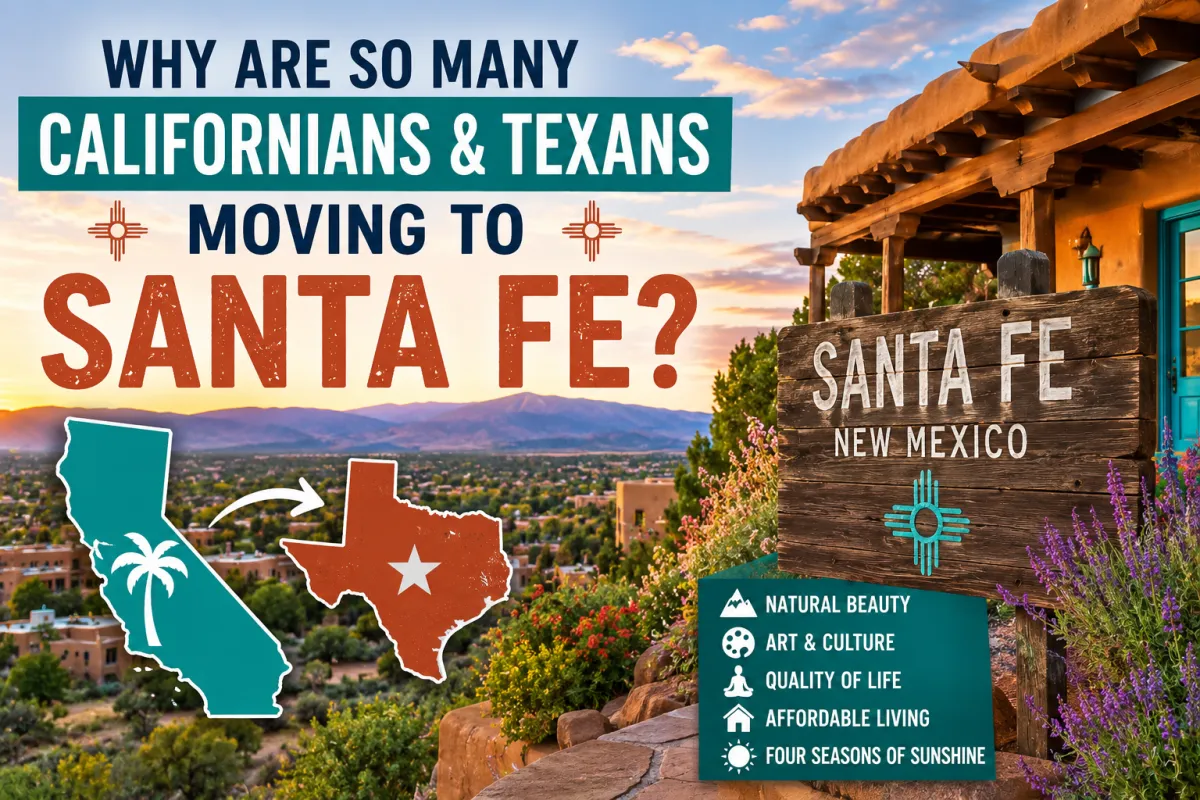
Why Are So Many Californians and Texans Moving to Santa Fe?
In the last twelve months, I've personally helped twenty-two families move to Santa Fe. Eighteen came from California. Three came from Texas. One came from Florida — and she'd moved to Florida from California three years earlier, hated it, and is now coming here. Something is happening, and in this guide I'll tell you exactly what it is.
As a Realtor here in Santa Fe, I work with a lot of people relocating for retirement or buying a second home — most of them in their fifties, sixties, and seventies. If you're considering the move yourself, here are the five reasons your future neighbors actually gave me, ranked by how often I hear them.
Why Are People Moving to Santa Fe? The Short Answer
People are moving to Santa Fe for five main reasons: the slower pace of life, a mild four-season climate with about 320 days of sunshine, a retiree-friendly tax picture (including very low property taxes), the "equity trade" of selling a high-priced California home and buying for far less here, and the city's rare cultural identity as the third-largest art market in the country. Below, I break down each one — ranked from the reason I hear least often to the one I hear most.
Reason 5: The Pace of Life
Starting at number five — and this is the one people apologize for, like it's somehow shallow — the pace of life. Santa Fe is slow. Drivers actually let you merge. Restaurant servers don't rush you. The post office line moves at a human speed. After thirty years in Los Angeles or Houston, that adjustment is jarring at first, and then it becomes the thing people tell me they love most. One client described it as "like my nervous system finally exhaled." That one stuck with me.
Reason 4: The Climate — Four Seasons Without the Extremes
Number four: actual four seasons, without the extremes. We get snow in winter, but it's usually gone by afternoon. Summers run in the eighties with low humidity and cool nights — you sleep with the windows open in July. It's a big part of what makes the city such a draw once summer hits.
For folks coming from Texas, relief from summer humidity is the single thing they mention most. For Californians, it's getting genuine winters without genuine cold. About 320 days of sunshine a year, almost no humidity ever — it's a climate that's genuinely hard to find anywhere else in the U.S.
Reason 3: The Tax Situation for Retirees
Number three — and this one gets bigger every year — taxes. New Mexico is not a zero-income-tax state like Texas or Florida. But for retirees, the picture has gotten much friendlier. Under recent legislation, most retirees with adjusted gross income under about $100,000 (single) or $150,000 (married filing jointly) pay zero state tax on Social Security. Pension and 401(k) income is taxed, but at relatively low rates compared to California.
Property tax is where Santa Fe really stands out. The effective rate in Santa Fe County runs around half a percent of market value — far below Texas, where many of my clients were paying two to two-and-a-half percent. There's also a value freeze available for residents 65 and older that locks in your assessed value. For someone selling a $1.5 million California home and buying an $800,000 home here, the property tax savings alone can run ten to fifteen thousand dollars a year. I always tell clients to talk to a CPA before they move — but the math usually works.
Reason 2: The Equity Trade
Number two is what I call the equity trade, and it's the most concrete reason people give me. Here's what it looks like: a couple sells their three-bedroom in Pasadena for $1.6 million and walks away with maybe $1.3 million after costs. They buy a beautiful adobe-style home in Eldorado or on the south side of Santa Fe for $750,000. They put the difference — $500,000-plus — into their retirement portfolio. That changes the entire math on retirement.
For Texas folks, the trade is a little different. Home prices in Austin and the Dallas suburbs have caught up to Santa Fe in many cases. But what you get for the price is different — you
u trade big-square-footage suburbia for character, walkability, mountains out your back door, and a city that actually has a center. That trade resonates with a lot of people in their fifties and sixties.
If you're trying to run these numbers for your own situation, the value of the home you're buying matters as much as the one you're selling — and Santa Fe pricing varies a lot by neighborhood and home type. I cover this in more depth in my guide on how much homes are worth in Santa Fe right now, and historic properties have their own pricing logic, which I break down in pricing a historic adobe home in Santa Fe.
Reason 1: The Identity of the Place
And number one — by far the biggest reason people give me — is the identity of this place. Santa Fe is the third-largest art market in the United States. We have a world-class opera. We have ten museums. We have green chile you cannot get anywhere else. We have hundreds of miles of hiking trails within twenty minutes of downtown. The food scene punches way above its weight.
People in their sixties tell me they didn't move here for retirement. They moved here because they wanted to live somewhere that fed their curiosity for the next twenty years. That's a different kind of move, and it attracts a different kind of person. If that resonates with you, you're going to fit in here. (And if you want a feel for how the city comes alive in summer, take a look at my roundup of things to do in Santa Fe in June).
Is Santa Fe Right for Everyone?
Honestly? No. The altitude is real. The dating scene at sixty is not Manhattan, I'll just say that. The healthcare is good but not Mayo Clinic. These are real tradeoffs, and I'd rather you hear them from someone honest before you move than discover them after.
But for the right person — someone craving a slower pace, a milder climate, a friendlier tax picture, and a city with genuine cultural depth — Santa Fe delivers in a way few places do.
Thinking About Making the Move?
If you're considering a move to Santa Fe and you want someone honest who's done this twenty-two times in the last year alone, reach out. Whether you're selling first or buying first, the order matters — and so does where the local market stands right now — which is also why I put together guides on the best time to sell a home in Santa Fe and how long it actually takes to sell a house here.
When you're ready to talk through your own situa
tion, send me a note — I'd be glad to help.
About Craig Cunningham, Santa Fe Real Estate Broker
I'm Craig Cunningham, a residential real estate broker in Santa Fe, NM, representing both buyers and sellers across Santa Fe, NM and the surrounding communities of Rancho Viejo, NM, Eldorado, NM, Las Campanas, NM, Aldea, NM, and the historic Eastside, NM. I became a broker after a 30+ year career in sales and marketing for upscale hotel brands, and I've carried many of those hospitality skills directly into the way I work with clients.
My goal is always to provide "concierge"-level service — anticipating my clients' needs and going above and beyond their expectations to make every real estate experience as stress-free and comfortable as possible. If you're moving to Santa Fe from California, Texas, or anywhere else, I'd be glad to be your guide.
Frequently Asked Questions About Moving to Santa Fe
Why are people moving to Santa Fe, NM?
The most common reasons are the slower pace of life, a mild four-season climate with around 320 days of sunshine, a retiree-friendly tax picture with low property taxes, the equity advantage of selling a higher-priced home elsewhere and buying for less in Santa Fe, and the city's strong cultural identity as a major art and food destination.
Is Santa Fe a good place to retire?
For many retirees, yes. New Mexico exempts Social Security from state tax for most retirees (AGI under ~$100,000 single / ~$150,000 joint), Santa Fe County property taxes are low, and there's an assessed-value freeze for residents 65 and older. Combined with the climate and lifestyle, it's a popular retirement destination.
How much are property taxes in Santa Fe?
The effective property tax rate in Santa Fe County is roughly half a percent of market value — significantly lower than states like Texas, where effective rates often run two percent or more.
Why are so many Californians moving to Santa Fe?
Californians are often drawn by the "equity trade" — selling a high-priced California home and buying a comparable or better Santa Fe home for far less — along with milder winters, lower property taxes, and a slower, more relaxed pace of life.
What are the downsides of moving to Santa Fe?
The main tradeoffs are the high altitude (around 7,000 feet, which takes adjustment), a smaller social and dating scene than a major metro, and good but not top-tier specialized healthcare. For the right person, these are outweighed by the lifestyle and cost-of-living advantages.




Disclaimer: All information contained on this website is deemed reliable but not guaranteed. All properties are subject to prior sale, change or withdrawal notice citydifferenthomes.com believes all information to be correct but assumes no legal responsibility for accuracy.